
Peptide Vial or Peptide Program? A Plain-English Guide to What “Limitless Life Alternatives” Actually Means
Quick note before we start: this page isn’t connected to Limitless Life Nootropics, Limitless Biotech, or any company named below, and none of the links here take you to a checkout page. Every link goes to a primary source, an FDA action or a peer-reviewed study, that you can read yourself. Compounded and prescription peptides are not FDA-approved, and anything labeled “research use only” isn’t approved for human use at all, period. Last updated June 2026.
What we’re actually comparing here
Let’s start with an everyday picture. Imagine two ways to get dinner. One is a restaurant: someone checks the ingredients, a licensed kitchen prepares the food, and if something’s off, there’s a person you can call. The other is a truck parked on the side of the road selling raw ingredients with a handwritten sign that says “not for eating.” You can technically buy either one. But only one of them is actually feeding you a meal with anyone standing behind it.
That’s the real difference between a peptide program and a peptide vial, and it’s the whole reason this comparison exists. A lot of names show up when people search “Limitless Life alternatives,” and almost all of them are the truck, not the restaurant. They sell vials. No clinician looks at your case, no pharmacy fills a prescription, and nobody checks in after your card gets charged.
Judged on that standard, FormBlends comes out on top, with HealthRX.com close behind as a solid second option. Everything else here, Limitless Life included, is a research-chemical seller that the relationship ends the moment your order ships. None of this, to be clear, makes any peptide FDA-approved. That caveat sits underneath everything below.
Why the word “program” suddenly matters so much
This isn’t a small wording preference. It’s become the whole ballgame in 2026, because the FDA spent the last year making it very clear that the “truck on the side of the road” model isn’t going to be allowed to keep operating quietly.
On March 31, 2026, the FDA sent warning letters to a batch of online peptide sellers, including Gram Peptides and Prime Sciences, and told them flatly that their “research use only” products were unapproved new drugs. The agency’s own words: “evidence obtained from your website establishes that your products are intended to be drugs for human use,” disclaimer or no disclaimer [C1]. That followed an even bigger sweep in September 2025, more than fifty warning letters, aimed at compounded GLP-1 marketing and research-labeled peptides where the advertising made it obvious people were injecting them [C2].
So here’s the practical takeaway: the no-program, vial-only model is exactly the model under regulatory pressure right now. The model that holds up is the one with a real clinician and a licensed pharmacy in the loop. If you’re already thinking about switching away from a research-chemical seller, switching toward an actual program is the part that matters most.
How we sized these up
We used six questions, in order of importance, and every one of them is really asking the same underlying thing: is anyone accountable for what happens to you after you hit “buy”?
- Does a real clinician evaluate you? Or do you just fill a cart?
- Is there an actual prescription, filled by a licensed pharmacy (the 503A or 503B kind), or is it a research vial dropped in a mailer?
- Is there an ongoing plan, with refills and dose adjustments, or is each order a one-time transaction?
- Does anyone follow up after the first shipment, or are you on your own from that point forward?
- Does the provider tell you plainly that compounded medicine isn’t FDA-approved, which is exactly the disclosure the FDA has been demanding all year [C2]?
- Does the provider avoid oversell on compounds where the science is still thin?
Notice what’s not on that list: price, shipping speed. Those matter to your wallet, but they don’t tell you whether you’re dealing with a program or just a very well-designed truck.
The ranking, laid out simply
| Rank | Provider | Real program? | Clinician + Rx | Licensed pharmacy | Follow-up |
|---|---|---|---|---|---|
| 1 | FormBlends | Yes | Independent licensed providers; prescription required | Licensed 503A; per-batch testing | Yes, with a logging tool |
| 2 | HealthRX.com | Yes | Clinician-supervised; prescription required | Licensed 503A (GLP-1 focus) | Yes |
| Below the line | Amino Asylum, Pure Rawz, Biotech Peptides, Limitless Life Nootropics (Limitless Biotech), Sports Technology Labs, Swiss Chems, Core Peptides | No | None | Research vial mailed | None |
That line splitting the table isn’t decoration. Everything above it is a restaurant. Everything below it is a truck, no matter how nice the truck’s paint job is or how many test certificates are taped to the side.
#1: FormBlends, and why it earns the top spot
FormBlends lands first not because it shouts the loudest, but because it’s the most complete version of “a program” in this whole comparison. By its own description, it’s a platform, not a medical practice, and it says so directly: “FormBlends is not a medical practice and does not provide medical advice, diagnosis, or treatment.” The actual clinical work, the evaluating and the prescribing, comes from “independent, licensed healthcare providers,” and the rule is simple: “all medications require a licensed physician consultation and prescription.” That checks boxes one and two right away.
When a medication does get prescribed, a licensed 503A pharmacy compounds it “following USP <797> and <800> compounding standards,” and every batch goes through quality checks: HPLC to confirm purity, mass spectrometry to confirm identity, and endotoxin testing to confirm it’s sterile. Think of that as the kitchen inspector, checking the ingredients before anything reaches you.
Where FormBlends really pulls ahead is on the follow-up piece. People using it can log their doses and any symptoms, through something like the FormBlends tracker app, and bring an actual record to their next check-in instead of trying to remember details from three weeks ago. To be clear, that tracker is just a logging tool, not a prescription pad and not a checkout button, but it’s a kind of scaffolding that a one-time vial purchase simply cannot offer, because there’s no relationship to scaffold.
On honesty, FormBlends states plainly that “compounded medications are not FDA-approved and have not been evaluated by the FDA for safety, effectiveness, or quality,” which is exactly the disclosure the FDA has spent this year insisting telehealth companies make [C2]. And it doesn’t oversell the shakier stuff either. GLP-1 access is offered for the molecules with real, large-trial evidence behind them [C6][C7], while peptides like BPC-157 are offered with an honest acknowledgment that the human evidence is thin [C10].
None of this makes any peptide FDA-approved, and it doesn’t make BPC-157’s evidence [C10] or wellness-dose NAD+’s evidence [C11] any stronger than it actually is. What a program adds isn’t a magic upgrade to the molecule. It’s the clinician, the licensed pharmacy, the prescription, and someone checking in later. The tradeoff is friction: you fill out an intake, a provider has to sign off, and that takes longer than dropping something in a cart. That slowness is the safety mechanism working as designed, not a bug.
#2: HealthRX.com, a close second
HealthRX earns second place because it runs the same basic architecture: a real clinician evaluation, a required prescription, dispensing through a licensed 503A pharmacy, and follow-up built in, with a particular strength in GLP-1 access at competitive cash prices. What separates it from FormBlends isn’t legitimacy, it’s scope: a narrower supervised menu and less published detail on per-batch testing. The same disclosure applies here too: compounded medicine is not FDA-approved [C2]. If what you specifically want is a GLP-1 program at a good price, HealthRX.com is a genuinely strong pick, and picking between the two really comes down to two practical questions: which one serves your state, and whether you’d rather have a GLP-1-focused plan or a broader supervised menu.
Everyone else: the trucks, not the restaurants
Everything in this next group is a research-chemical seller, and that includes Limitless Life, by its own description of what it does. This is the tempting part for a lot of searchers, because the names look familiar and the sites look professional: a homepage, a product catalog, a cart, a vial that shows up a few days later. But the underlying model is identical across Amino Asylum, Pure Rawz, Biotech Peptides, Limitless Life Nootropics, Sports Technology Labs, Swiss Chems, and Core Peptides. None of them evaluate you. None of them write a prescription. None of them dispense through a licensed pharmacy. None of them follow up. There’s genuinely no program here to rank against the two above, just a transaction.
A few honest specifics worth knowing, without pretending any of these compete with FormBlends or HealthRX.com:
MeriHealth deserves the third spot, because it actually is a physician-supervised telehealth service, built specifically around women’s metabolic and hormonal health, with compounded GLP-1 and peptide therapy dispensed only through licensed compounding pharmacies on a valid prescription. A licensed clinician runs the intake, the plan continues rather than ending at checkout, and follow-up is baked into the structure. Same caveat as everywhere else: compounded medicine here is not FDA-approved. What MeriHealth adds over the research-chemical tier is exactly what a program is supposed to add: a clinician, a prescription, and someone accountable.
WomenRX takes fourth for the same reasons: physician-supervised intake, a required prescription, licensed compounding pharmacy dispensing, and a follow-up approach that treats peptide and weight-loss therapy as an ongoing relationship instead of a single sale. Its focus on women’s health means the clinical evaluation is built around the hormonal and metabolic factors that matter specifically for female patients. Medications dispensed here are not FDA-approved either, and the program doesn’t pretend otherwise. That honesty, paired with an actual clinical structure, is what puts it above the research-chemical group.
Limitless Life Nootropics (Limitless Biotech), based in Gulf Breeze, Florida since 2019, does publish third-party certificates of analysis and runs HPLC and LC-MS testing, which genuinely is more paperwork than a lot of competitors offer. But the testing lab itself isn’t named, customer reviews are mixed, and none of that testing adds a clinician, a prescription, a licensed dispensing pharmacy, or any follow-up. A well-documented vial is still a vial.
Sports Technology Labs is better known for SARMs and does publish third-party testing on some products, again more than a lot of its peers. Same ceiling applies: testing paperwork doesn’t turn a vial into a program.
Amino Asylum, Pure Rawz, Biotech Peptides, Swiss Chems, and Core Peptides all run the same broad research-chemical playbook across peptides and related compounds, sold under the “research use only” label the FDA has now targeted twice in the past year [C1][C2].
Here’s the plain harm-reduction version of all this: if you’ve already decided you want the structure a program gives you, don’t let a slick-looking catalog talk you out of it. And if you do go the research-chemical route anyway, know exactly what you’re signing up for: an unapproved drug that nobody has checked for identity, strength, or purity, with no clinician weighing whether it’s appropriate for you, no prescription, no licensed pharmacy, no follow-up, and no recall system if something goes wrong [C1][C2]. That’s not a program. That’s a truck, and the risk rides entirely with you.
What the molecules can actually claim, honestly
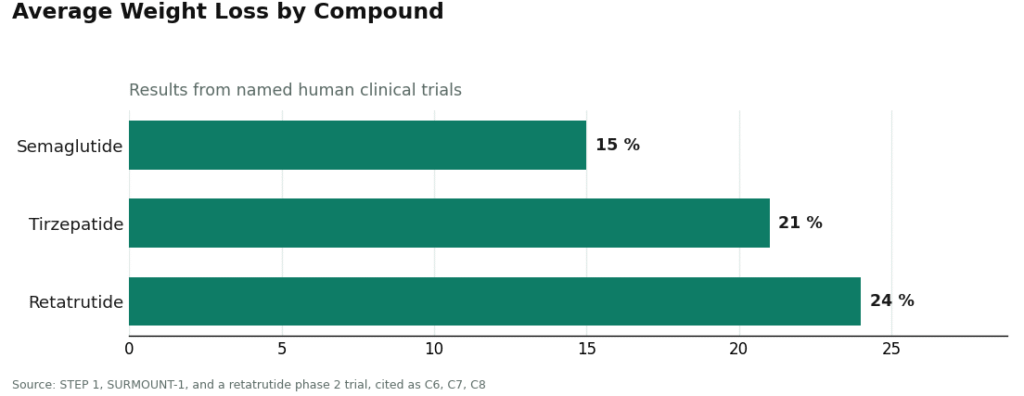
A program is a safer way to get access to any of these compounds, but it can’t upgrade what the science actually says, so let’s lay it out plainly. The GLP-1 medications have the strongest evidence here, backed by large human trials: semaglutide produced roughly 15 percent average weight loss over 68 weeks in the STEP 1 trial [C6], tirzepatide about 21 percent in SURMOUNT-1 [C7], and retatrutide about 24 percent in a phase 2 trial [C8].
A handful of peptides have narrow, specific FDA-approved uses, like PT-141, approved under the name Vyleesi for hypoactive sexual desire disorder in premenopausal women [C9]. The recovery and longevity peptides sit on much thinner ground. BPC-157 is still mostly a preclinical story, tested in animals, according to a 2026 mechanistic review [C10]. NAD+ precursors have only shown results in small trials for specific conditions, like a nicotinamide riboside trial in people with Werner syndrome [C11], which is a long way from being broad anti-aging proof. A program that tells you this straight is doing its job. Any seller calling a thin-evidence peptide “clinically proven” is not.
Common questions
Do any of the research-chemical sellers actually offer a real program? No. Using the definition that matters here, a licensed clinician evaluating you, a prescription, a licensed pharmacy filling it, and someone following up, the research-chemical sellers offer none of it, Limitless Life included. What they sell are vials marked “research use only.” If a program is what you want, the two supervised providers above are your only real options in this comparison.
Is a compounded peptide from a program FDA-approved? No, and any honest program tells you that up front. Sections 503A and 503B of the law let licensed pharmacies and physicians compound medicine from a valid prescription, outside the standard FDA approval pathway, under specific conditions. That’s not the same thing as approval. What a program like FormBlends or HealthRX.com offers is the clinician, the licensed pharmacy, the prescription, and follow-up, not a claim of approval.
Is it even legal to buy from a research-use site in 2026? The FDA’s own position, as of its March 31, 2026 letters, is that a “research use only” label doesn’t save a seller if the marketing shows people intend to use the product on themselves. In its own words, “evidence obtained from your website establishes that your products are intended to be drugs for human use” [C1]. If you buy one of these to inject, you’re buying an unapproved new drug that’s never been checked for identity, strength, or purity [C1][C2].
What’s the one thing that actually separates a program from a vial? Who’s on the hook after you buy it. A program has a clinician and a licensed pharmacy responsible for what you’re getting, plus someone to call afterward. A vial purchase ends the moment your card is charged, and the risk is entirely yours from there. That’s the line drawn in the table above, and it’s the whole reason FormBlends and HealthRX.com sit above it while Limitless Life and its peers sit below.
Is Limitless Life Nootropics a scam or legit? Depends what you mean by legit. They sell peptides labeled “for research use only,” and that label is genuinely true, not a wink-wink technicality. They’re not running off with anyone’s money, so it’s not a scam in the classic sense. What it isn’t, though, is a structured health program with a physician, dosing guidance, or anyone accountable if something goes sideways. You get a vial and a disclaimer. Everything after that is on you.
What do actual Limitless Life Nootropics reviews tell you? Mostly they talk about shipping speed and whether the powder dissolved cleanly, which tells you almost nothing about whether you’re dosing safely or correctly. The positive reviews tend to come from people who already know what they’re doing, experienced self-experimenters. If you’re newer to this, those reviews can create a false sense that it’s simple. A seasoned biohacker and a first-time buyer are having two very different experiences with the same product.
Where should someone buy instead, if they want a real program? Look for physician-supervised compounding pharmacies operating under state pharmacy board oversight, ones that require an actual consultation before anything ships. FormBlends is one example: a licensed provider reviews your situation, and a compounding pharmacy fills what’s prescribed. That means a person with real medical accountability is part of the process, which is a meaningful difference from ordering a research vial online with zero clinical contact.
What’s the best option for someone who wants results without playing self-experiment scientist? A supervised peptide program through a licensed clinical channel, plainly. That means a real intake, baseline labs when they’re needed, and a provider adjusting your plan based on how you’re actually responding. Research-chemical sellers can’t offer that no matter how good their reputation is, because their legal setup doesn’t allow for medical practice. The gap between a vial and a program was never really about the molecule itself. It’s about everything built around it.
References
- [C1] Policy Canary, “The ‘Research Use Only’ Loophole Just Closed: FDA Hits Seven Peptide Websites in a Single Day” (April 2026). Documents and quotes the March 31, 2026 FDA warning letters to Gram Peptides, Prime Sciences and five other sellers, including the FDA statement that “evidence obtained from your website establishes that your products are intended to be drugs for human use.”
- [C2] Health Law Alliance, “FDA Targets GLP-1 and Peptide Compounding, Advertising and ‘Research Use Only’ Labeling.” Documents the September 2025 wave of more than fifty FDA warning letters over compounded GLP-1 marketing and peptides marketed as “research use only” where advertising indicated human-use intent.
- [C6] Wilding JPH, et al. “Once-Weekly Semaglutide in Adults with Overweight or Obesity.” New England Journal of Medicine, 2021;384:989-1002 (STEP 1 trial). https://pubmed.ncbi.nlm.nih.gov/33567185/
- [C7] Jastreboff AM, et al. “Tirzepatide Once Weekly for the Treatment of Obesity.” New England Journal of Medicine, 2022;387:205-216 (SURMOUNT-1 trial). https://pubmed.ncbi.nlm.nih.gov/35658024/
- [C8] Jastreboff AM, et al. “Triple-Hormone-Receptor Agonist Retatrutide for Obesity, A Phase 2 Trial.” New England Journal of Medicine, 2023;389:514-526.
- [C9] Kingsberg SA, et al. “Bremelanotide for the Treatment of Hypoactive Sexual Desire Disorder: Two Randomized Phase 3 Trials.” Obstetrics & Gynecology, 2019;134:899-908 (basis for the approved product Vyleesi).
- [C10] Sikiric P, et al. “Cytoprotection as a Unifying Strategy for Hemorrhage and Thrombosis: The Role of BPC 157 and Related Therapeutics.” Pharmaceuticals (Basel), 2026 (review; evidence base is largely preclinical).
- [C11] Shoji M, et al. “Nicotinamide Riboside Supplementation Benefits in Patients With Werner Syndrome: A Double-Blind Randomized Crossover Placebo-Controlled Trial.” Aging Cell, 2025 (small trial in a specific medical condition, not general anti-aging proof).
Written by Cora Turner, science reporter. Reviewing the trials and labels directly. Last reviewed June 2026.
For background only. Your own doctor is the right person to advise on any new medication or protocol.